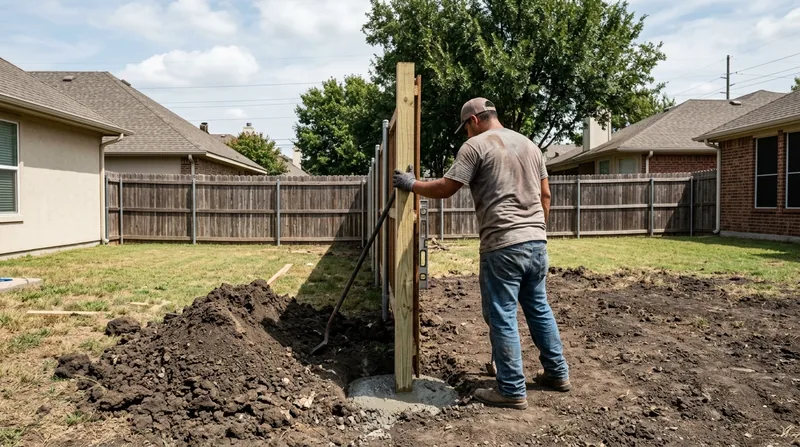




A fence post repair in Dallas is almost never about the fence panels themselves. The real culprit is the post footing, and here in Dallas, the cause is Houston Black clay. This soil swells when wet and shrinks when dry, heaving posts out of plumb and racking entire fence lines. Unlike northern climates where frost heave is the enemy, Dallas homeowners face a seasonal clay cycle that destabilizes footings year after year. When a fence leans, lists to one side, or shows visible gaps between pickets and rails, the post has shifted. We dig out the old footing, reset the post in concrete sized for clay movement, and restore your fence line to plumb. The repair typically holds, costs far less than replacing the entire fence, and can be matched to wood, vinyl, or chain link fence styles.
Why Fence Posts Fail in Dallas: Clay, Moisture, and Time
Dallas sits on expansive clay that is the defining fact of every leaning fence in this market. When summer rains soak the ground, clay swells and pushes posts upward. When drought dries the soil, clay shrinks and leaves voids beneath the footing. Posts that were set shallow, tamped without concrete, or installed in older fences before concrete-set standards became routine are the most vulnerable. Even a post set in concrete can fail if the concrete collar is too shallow, if drainage is poor, or if the original installation did not account for clay movement. Water pooling around the base accelerates rot at the ground line, especially in untreated wood. The result is a leaning post that pulls the entire fence out of square.
- Posts set shallow or tamped only shift with clay expansion and contraction cycles.
- Concrete-set posts fail when the footing is too small or too shallow for clay heave.
- Water drainage around the base rots wood at the ground line and weakens the post structurally.
- Older fencing, especially cedar or pressure-treated pine installed before modern methods, often needs post replacement after 15 to 20 years.
- A single leaning post can rack the rails and pickets across 10 to 20 linear feet of fence line.
Identifying the post as the problem, not the panels, is the first step to a lasting repair.
Key info: In Dallas, Garland, and Richardson, the wet-then-dry clay cycle of late summer is when fence posts heave most visibly. If your fence leans after a dry spell, the post footing has likely shifted. We can often repair the post in place rather than remove and replace the entire fence section.
For more detail on what happens to fence structures in storms, see our storm damage fence repair service.
How We Repair and Replace Fence Posts in Dallas: Step by Step
Our process starts with a site visit to assess the post, the footing, and the condition of the surrounding fence panels. We determine whether the post can be reset in place or must be removed and replaced. If the post is sound but the footing has failed, we dig out the old concrete, reset the post plumb, and pour new concrete sized for Dallas clay movement. If the post is rotted, cracked, or severely compromised, we remove it, install a new pressure-treated or cedar post to match your fence, and set it in concrete. We then reattach the rails and pickets, check alignment across the fence line, and finish to match your existing fence style.
- We verify the property line and utility locates (811 call required by law) before any digging begins.
- We dig out the old footing to below the frost line and remove any rotted concrete or soil.
- We reset or install the post plumb using a level and bracing.
- We pour concrete sized for clay heave, typically 18 to 24 inches deep with a wider base for lateral stability.
- We reattach rails and pickets, match the fence line, and verify the repair is square and level.
The entire job typically takes one day for a single post and repair, depending on footing depth and concrete cure time.
Local example: A homeowner in Irving noticed her privacy fence leaning away from the property line after a hot, dry August. We dug 22 inches deep, found the original footing was only 10 inches, reset the post in concrete with a wider base, and the fence held plumb through the next wet season. The repair cost less than half the price of replacing that section.
For comprehensive fence repair across all styles and damage types, see our general fence repair service.
Repair Versus Replacement: Methods and Best Use
| Approach | Description | Best for |
|---|---|---|
| Reset in Concrete | Dig out old footing, reset post plumb, pour new concrete 18 to 24 inches deep with wider base. | Post is structurally sound but footing has failed due to clay heave or shallow original set. |
| Post Replacement | Remove damaged post, install new pressure-treated or cedar post, set in concrete sized for clay movement. | Post is rotted, cracked, or severely compromised at or below the ground line. |
| Partial Section Rebuild | Replace multiple consecutive posts, rails, and pickets; re-set all posts in concrete; match existing fence profile. | Two or more adjacent posts have failed, or storm damage has racked an entire section out of plumb. |
| Anti-Sag Bracing | Install diagonal or horizontal bracing between posts to resist racking and wind load without replacing posts. | Posts are sound but fence is racked or sagging, and cost is a priority over perfect restoration. |
Each approach has a cost and a timeline. Repair is always our first recommendation when the post itself is salvageable, because it preserves the existing fence line and costs significantly less than full section replacement.
Fence Post Repair and Replacement Cost in Dallas: What to Expect
Post repair and replacement costs in Dallas typically start at $425 for a single post reset in concrete, and range upward depending on footing depth, soil conditions, and whether the post itself must be replaced. A full post replacement with new pressure-treated or cedar material usually runs $550 to $850 per post, including removal, new post installation, and concrete. Multiple adjacent posts or a partial section rebuild will be higher and requires an on-site estimate. Factors that affect the final price include the depth required for clay heave (typically 18 to 24 inches), whether the old concrete must be removed and hauled, the species and size of the replacement post, and access to the post location. Getting 2 to 3 estimates from local contractors is smart practice, because footing depth and soil conditions vary across Dallas neighborhoods and can significantly change the scope and cost.
For a detailed pricing breakdown across all our services, including post repair, see our full pricing overview.
A free, no-obligation estimate is the best way to know what your repair will cost. Call us at (469) 737-9552 or request an estimate online.
Hiring a Fence Post Repair Contractor Near Me: What Dallas Homeowners Should Know
When you are looking for a fence post repair contractor near you in Dallas, Irving, Plano, or the surrounding areas, a few key factors separate a solid repair from a costly mistake. First, verify that the contractor carries full general liability and workers' compensation insurance and can provide a certificate of insurance on request. In Texas, fence installation is not regulated by a state license, so licensing is set county by county, and requirements vary across Greater Dallas. Ask the contractor to explain the local permit rules for your specific address, because some jurisdictions in Dallas County, Tarrant County, and Collin County require permits for fence work and others do not. If your fence is in a master-planned community or HOA subdivision, confirm that any replacement post will meet height, material, and color standards before work begins. Finally, get 2 to 3 estimates, ask for references from recent post repair jobs, and choose a contractor who explains the repair method and why it will hold, not one who pushes you to replace the entire fence.
- Verify full general liability and workers' compensation insurance with a current certificate available on request.
- Ask about local permit requirements, because they vary across Dallas-area jurisdictions and affect timeline and cost.
- Check HOA or deed restrictions before approving a replacement post, especially in master-planned communities where color and material standards are strict.
- Request references from past post repair jobs and ask how long the repair has held.
- Understand the repair method and why the contractor chose reset versus replacement before you approve the work.
A contractor who listens, explains the problem clearly, and proposes repair before replacement is the one to trust.
Ready to get started? Contact us for a free estimate at (469) 737-9552.
Fence Post Repair & Replacement in Dallas: Pricing Guide
| Service | Price | Details |
|---|---|---|
| Single Post Reset in Concrete | Starting at $425 | Footing depth 18 to 24 inches, concrete pour, post reset plumb, no post replacement needed |
| Post Replacement (Pressure-Treated or Cedar) | Starting at $550 | Includes removal of old post, new post installation, concrete footing, and reattachment of rails and pickets |
| Multiple Posts or Partial Section Rebuild | On estimate | Two or more adjacent posts, full section reset, storm damage repair, or complex access require on-site assessment |
| Anti-Sag Bracing (Alternative to Full Replacement) | Starting at $300 | Diagonal or horizontal bracing installed to resist racking and wind load without replacing posts |
| Travel and Estimate | Free | No mileage or call-out fee in Dallas and surrounding service areas, response within 24 hours |
Indicative pricing, the exact cost depends on square footage, finish, and site access. Free personalized estimate within 24h at (469) 737-9552.


