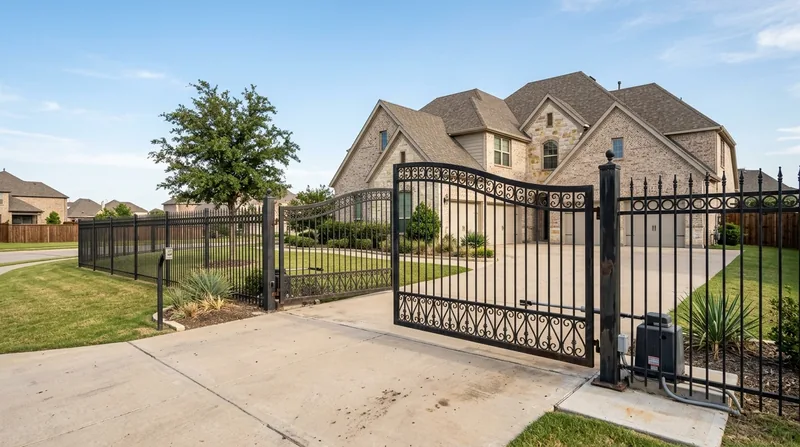




A driveway gate installation in Dallas transforms property access and security, but it demands precision in design, permitting, and electrical setup. Across Dallas subdivisions from Plano to Arlington, automatic gates sit at the intersection of HOA architectural standards, local building codes, and homeowner convenience. The expansive clay soil beneath most Dallas properties means gate posts must be set deep and true in concrete footings to resist the heave and settlement cycles that plague this region. Whether you need a swing gate for a narrow driveway or a sliding cantilever gate for a wide entry, the opener, safety sensors, and access control have to work flawlessly in Texas heat and humidity. We install and repair automatic gate systems that meet local standards and perform reliably year after year.
Why Automatic & Driveway Gates Matter in Dallas Subdivisions
Master-planned communities across the Dallas area enforce strict HOA architectural guidelines that govern gate materials, colors, height, and setback from the property line. A gate that looks right and functions smoothly adds genuine curb appeal and security without triggering compliance issues. Dallas clay soil is the hidden challenge: posts set in loose backfill or shallow footings will heave and tilt within a season or two, leaving gates misaligned and openers strained. Proper installation means setting posts in concrete at depth, accounting for the local soil's seasonal movement, and wiring the opener with redundant safety features so the gate stops and reverses if it encounters an obstacle.
- Verify gate design and height limits with your HOA architectural committee before ordering materials or breaking ground.
- Have a licensed land surveyor or property survey identify your exact property line and setback requirements, since corner visibility and easement rules vary by municipality.
- Call 811 at least three business days before any digging to locate buried utilities, a legal requirement in Texas.
- Install posts in concrete footings set below the frost line and below the active clay movement zone, typically 36 to 42 inches deep in this region.
- Wire the opener with a backup power supply and safety sensors that stop the gate if a vehicle, person, or object is in its path.
These steps ensure your gate meets code, stays true through weather cycles, and operates safely every day.
Key info: Dallas and suburban jurisdictions like Frisco, Plano, and Richardson each set their own gate height limits, setback rules, and permit requirements. Some allow 6-foot gates at the property line; others cap them at 4 feet or require a 5-foot setback from the street. Always check with your city or county building department and your HOA before finalizing your gate design. Visit the City of Dallas Building Permits office or your local jurisdiction's website for current code.
How We Install Automatic Gates in Dallas: From Survey to Power-Up
Our process starts with your existing survey or property identification and a walk-through to assess driveway width, slope, soil conditions, and HOA requirements. We confirm gate type, swing versus sliding, opener capacity, and access control method before we order materials or set a post hole. Once you approve the design and we obtain any required permits, we call 811 for utility locates, then dig and set posts in concrete footings engineered for Dallas clay movement. We mount the gate frame, hang the panels or slats, wire the opener and safety sensors, program access codes or remotes, and test every function before you take over the key.
- Review your property survey and confirm property line, setback, and HOA architectural standards with you in writing.
- Call 811 for utility locates and wait for the clear-to-dig marking before breaking any ground.
- Excavate post holes to depth, set posts in concrete footings, and allow concrete to cure per manufacturer spec before hanging the gate.
- Mount gate frame, hang panels or slats, and install hinges or rollers aligned for smooth operation.
- Wire the opener, install safety sensors and breakaway hardware, and program access codes or remotes.
- Test gate operation, sensor response, and emergency manual release, then walk you through daily use and maintenance.
This methodical approach prevents costly rework and ensures your gate operates safely and stays compliant with local code.
Example: A homeowner in Richardson ordered a 12-foot sliding cantilever gate with a linear actuator opener and keypad entry. Our crew set the posts 42 inches deep in concrete, installed the gate track on a slight grade to ensure proper drainage, and wired the opener with battery backup and motion sensors. The gate now slides open in 8 seconds and closes on a 30-second delay. Total time on site was three days. See our gate installation and repair page for more examples and details.
Gate Installation Methods: Swing vs. Sliding
| Approach | Description | Best for |
|---|---|---|
| Swing Gate | Hinged at one or both sides, swings inward or outward on a V-track or cantilever hinge system. Requires 180-degree clearance and strong posts to resist torque. | Narrower driveways under 10 feet, rural or estate properties where clearance is ample, and classic or ornamental gate aesthetics. |
| Sliding Gate | Rolls on a ground track or cantilever rail, slides parallel to the fence line. Needs 100% of gate width as clear space to the side but no swing-out clearance. | Wide driveways over 12 feet, steep slopes, limited clearance to one side, and high-traffic commercial or multi-unit residential entries. |
| Cantilever Sliding | Slides on a cantilever arm anchored to a single post, no ground track. Eliminates trip hazards and drainage issues. Requires a very strong post and deep footing. | Driveways prone to standing water or snow, properties with gravel or unpaved surfaces, and high-security or commercial gates. |
| Automatic Opener | Hydraulic, pneumatic, or electric motor that opens and closes the gate on command. Includes safety sensors, breakaway hardware, and backup power or manual override. | All automatic gates. Essential for daily convenience, security, and meeting local accessibility and safety codes. |
Automatic & Driveway Gates Cost in Dallas: What to Expect
A basic automatic driveway gate installation starts at around $2,900 for a single-swing gate with a standard opener, safety sensors, and one remote control on a level driveway with standard soil conditions. A sliding cantilever gate with keypad access, battery backup, and motion sensors typically runs $4,500 to $6,500 depending on gate width and opener capacity. Factors that increase cost include deep or difficult post holes in rocky or clay-heavy soil, a steeply sloped driveway requiring grade adjustments, ornamental or custom gate design, and multiple access methods such as keypads, remotes, and phone-based entry. If your driveway is longer than 150 feet or requires trenching for electrical conduit, labor and materials rise accordingly. Getting two or three estimates from established local contractors is always smart, because site conditions and material choices vary widely. Visit our pricing page for a detailed breakdown of gate types and typical ranges in the Dallas area.
Automatic & Driveway Gates Near Me: What Dallas Homeowners Should Know Before Hiring
When you call a gate contractor, ask whether they carry full general liability and workers' compensation insurance and request a certificate of insurance naming your property. Confirm that they understand Dallas-area HOA rules and local building code, especially setback and height limits in your specific subdivision or municipality. Texas does not issue a state license for fence or gate installation, so licensing is set county by county or by individual municipalities; always verify permit requirements with your city or county building department before work begins. Get references from recent gate installations in your area, ask to see photos of completed jobs, and understand the warranty on both the gate hardware and the opener system. Most reputable contractors offer free estimates, respond within 24 hours, and explain the scope and timeline clearly before you commit. Call us at (469) 737-9552 for a free, no-obligation estimate, or visit our contact page to request a consultation.
We are fully insured and an AFA Member Installer with the American Fence Association, in business since 2012. We work across Dallas, Irving, Garland, Grand Prairie, Mesquite, Richardson, Plano, Frisco, McKinney, and surrounding areas, and we are happy to repair automatic gate openers, replace damaged panels, or upgrade an older gate system to modern access control.
Automatic & Driveway Gates in Dallas: Pricing Guide
| Service | Price | Details |
|---|---|---|
| Single-swing gate with standard opener | Starting at $2,900 | Includes posts set in concrete, basic hinges or V-track, single-channel opener, one remote, and safety sensors |
| Sliding cantilever gate with keypad and battery backup | Starting at $4,500 | Includes cantilever post footing, linear actuator, keypad entry, motion sensors, and emergency manual release |
| Wide or dual-swing gate with dual openers and phone access | Starting at $5,200 | Includes two synchronized openers, dual safety sensors, smartphone app control, and heavy-duty hinges for wide openings |
| Complex installation with steep grade, rocky soil, or long driveway | On estimate | Site conditions such as difficult digging, grade changes, long electrical runs, or custom design require an on-site assessment |
| Opener repair or sensor replacement | Starting at $650 | Troubleshooting, parts replacement, safety sensor realignment, and programming of remotes or keypads |
| Free estimate and travel | No charge | Response within 24 hours at (469) 737-9552, included in Dallas and surrounding service areas, no obligation to book |
Indicative pricing, the exact cost depends on square footage, finish, and site access. Free personalized estimate within 24h at (469) 737-9552.


