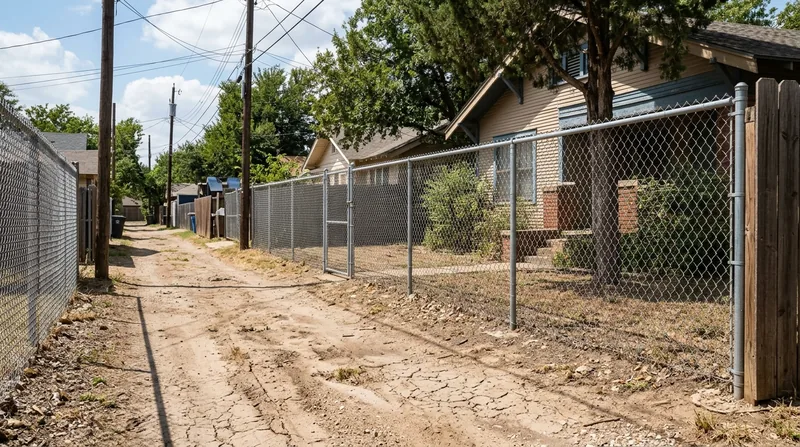




Chain link fence installation in Dallas is the practical choice for side lots and alley lines where budget matters and the clay soil moves with every wet and dry cycle. The Blackland Prairie clay that dominates Greater Dallas swells in summer rain and shrinks in drought, which heaves and racks fence posts over time. Chain link handles that movement better than rigid materials because the mesh flexes, and when posts are set deep enough in concrete, the line stays straight for years. We install chain link fences across Dallas, Irving, Garland, and the surrounding communities, setting posts to resist the soil conditions that wreck most fences in this region. If you need a durable, low-maintenance fence that won't rot at the ground line or warp in the Texas heat, chain link is a solid choice.
Why Chain Link Fence Installation Matters in Dallas Soil Conditions
Dallas sits on expansive clay that moves significantly with moisture changes. A fence post set shallow or in loose soil will heave upward in wet months and leave gaps at the base when the clay dries. Chain link mesh won't split or splinter like wood, and the galvanized or powder-coated steel won't rot at the ground line the way cedar or pressure-treated pine does. The fence stays functional and straight because the material itself is forgiving of the soil movement that defines this region.
Chain link also requires minimal maintenance compared to wood fences, which need cleaning, staining, and repair every few years in Dallas humidity. The initial cost is lower, and the long-term expense of upkeep is nearly zero. For rental properties, side lots, dog runs, and commercial boundaries, chain link is the most cost-effective fence that holds up to local conditions.
- Posts are set at least 3 feet deep in concrete to resist clay heave and keep the line plumb year-round.
- Galvanized or powder-coated mesh resists rust and requires no painting, staining, or chemical treatment.
- The fence flexes with soil movement instead of cracking, splitting, or leaning like rigid panels do.
- Installation runs year-round because Dallas clay rarely freezes, making spring and fall ideal but summer and winter equally viable.
- Chain link meets HOA requirements in many Dallas subdivisions when height and material standards are specified in the deed restrictions.
All of these factors combine to make chain link the right choice when durability and budget align. For more information on how soil conditions affect fence performance in this region, see our fence post repair and replacement service, which addresses the heave and settlement issues that affect all fence types here.
Key info: Texas 811 utility locates are required by law before we dig any post holes. We call 811 on every job to locate underground gas, electric, water, and telecommunications lines. The locate is free, takes 2 to 3 business days, and protects you from liability and service interruptions. We schedule installation only after the locate is marked.
How We Install Chain Link Fencing in Dallas: The Process
Chain link installation begins with a site survey to confirm the fence line, measure the distance, and identify underground utilities. We call 811 for a free utility locate, which marks gas, electric, water, and telecommunications lines so we dig safely. Once utilities are marked, we set posts at the correct spacing, depth, and alignment, then stretch the mesh tight and secure it with tension bands and stretcher bars. The entire process takes 2 to 5 days depending on the linear footage and site access.
The key to a fence that stays straight in Dallas clay is post depth and concrete setting. Shallow posts heave and lean within a year. We dig post holes at least 3 feet deep, set posts in concrete, and tamp the soil firmly around the concrete collar. The concrete keeps the post locked in place as the clay swells and shrinks, preventing the upward movement that causes gates to stick and mesh to sag.
- We measure the fence line and confirm property boundaries with the customer before marking anything on the ground.
- A call to 811 locates all underground utilities at no cost, and we wait for the locate to be marked before digging.
- Posts are spaced 6 feet apart for residential chain link and set at least 3 feet deep in concrete for stability in clay soil.
- Mesh is stretched tight using a mechanical stretcher, then secured to each post with tension bands and a stretcher bar to prevent sagging.
- Gates are hung plumb with self-closing hinges and latches so they operate smoothly regardless of soil movement.
- All hardware is galvanized or stainless steel to resist rust in Dallas humidity and clay contact.
The result is a fence that remains plumb and functional for 15 to 20 years with no maintenance beyond occasional rinsing. If you need a gate as part of your installation, see our gate installation and repair service for details on hinge types, self-closing hardware, and cantilever designs that work in this climate.
Local example: A residential property in Richardson with a 150-linear-foot side lot fence takes about 3 days to complete. Posts are set 6 feet apart (25 holes), the mesh is stretched tight, and gates are hung with self-closing hinges. The homeowner has a finished fence that requires zero maintenance and will outlast the house if the posts stay set in concrete.
Chain Link Fence Installation Methods and Materials
| Approach | Description | Best for |
|---|---|---|
| Residential galvanized chain link | Standard 11-gauge mesh, 1.25-inch diamond, galvanized coating for rust resistance. Posts set 3 feet deep in concrete, spaced 6 feet apart. | Side lots, alley lines, dog runs, and residential property boundaries in Dallas neighborhoods. |
| Black vinyl-coated chain link | 11-gauge galvanized steel mesh with black PVC coating for appearance and durability. Resists rust and UV fading, blends with landscaping. | Residential properties where appearance matters and homeowners want a finished look without the cost of vinyl or wood. |
| Privacy slats for chain link | Vinyl or polyethylene slats woven into the mesh to block sight lines. Available in green, brown, tan, and black. Does not add structural strength but improves aesthetics. | Residential properties where privacy is desired without replacing the entire fence with wood or vinyl. |
| Heavy-gauge commercial or farm chain link | 9-gauge or 6-gauge mesh, larger diamond openings, posts set deeper and spaced closer. Posts often set in concrete sleeves for easy removal. | Commercial properties, farm and ranch boundaries, temporary construction fencing, and high-impact areas requiring maximum durability. |
Each method is installed using the same core principles: posts set deep in concrete, mesh stretched tight with mechanical equipment, and hardware secured with tension bands and stretcher bars. The choice of gauge, coating, and slat type depends on your budget, the purpose of the fence, and how long you expect to keep it. We recommend 11-gauge galvanized or black vinyl-coated mesh for most residential applications in Dallas because it balances cost, durability, and appearance.
Chain Link Fence Installation Cost in Dallas: What to Expect
Chain link fence installation in Dallas starts at approximately $15 per linear foot for standard 11-gauge galvanized mesh with posts set 6 feet apart and 3 feet deep in concrete. A typical 150-foot residential side lot fence runs between $2,250 and $3,000 depending on site conditions, soil type, and whether the fence includes gates. Black vinyl-coated mesh costs 20 to 30 percent more than galvanized because of the coating and appearance upgrade. Privacy slats add $2 to $4 per linear foot to the total.
Several factors move the price up or down. If post holes are difficult to dig because of clay density, rock, or tree roots, labor increases. If the fence line slopes or steps to follow the terrain, installation takes longer. If the property requires multiple gates or has limited access for equipment, costs rise. Conversely, a long straight fence on level ground with good access costs less per foot than a short fence with obstacles.
We recommend getting 2 to 3 estimates from different installers so you understand what's included at each price point. Some contractors cut corners by setting posts shallow, skipping concrete, or using undersized mesh. When you compare estimates, ask how deep posts are set, whether concrete is used, what gauge mesh is specified, and whether hardware is galvanized or stainless steel. The lowest price is rarely the best value if the fence leans or sags within a few years.
For a detailed pricing breakdown and to see how your specific project fits into our rate structure, visit our pricing page or call (469) 737-9552 for a free, no-obligation estimate. We respond within 24 hours and can schedule a site visit at your convenience.
Chain Link Fence Installation Near Me: What Dallas Homeowners Should Know Before Hiring
When you search for chain link fence installers near Dallas, you will find national franchises, local contractors, and handymen all offering the service. The difference is in how the work is done and who stands behind it. We recommend choosing an installer who carries full insurance covering general liability and workers' compensation, sets posts deep in concrete rather than shallow or tamped, and can explain why those choices matter in Dallas clay.
Texas issues no state license for fence installation, so there is no contractor license to verify. Fence licensing here is set county by county, and Dallas County does not require a license for residential fence work. However, projects at or above $40,000 in value may require a licensed general contractor, so confirm with the Dallas city building department or your local jurisdiction before hiring. We are fully insured and hold membership in the American Fence Association, and we can provide a certificate of insurance on request.
Check references from any installer you consider. Ask to see completed fences and speak with homeowners who have had work done in the past 2 to 3 years. If a fence is leaning, sagging, or rusted heavily, that tells you something about how the installer set posts and chose materials. Ask about HOA approval if you live in a master-planned community like Frisco, Plano, or Addison, because deed restrictions often govern fence height, material, and color. We verify HOA requirements before submitting an estimate.
Finally, understand that permits are required in some Dallas jurisdictions and not others. The city of Dallas requires a fence permit for most installations, while some surrounding cities do not. We check permit requirements with your local building department before we start work, and we obtain any required permits on your behalf. This protects you from code violations and ensures the fence meets local standards for height, setback, and material.
To get started, call us at (469) 737-9552 or visit our contact page to request a free estimate. We will survey your property, explain the installation process, confirm permit requirements, and provide a detailed quote with no obligation to book.
Chain Link Fence Installation in Dallas: Pricing Guide
| Service | Price | Details |
|---|---|---|
| Standard residential galvanized chain link | Starting at $15/ft | 11-gauge mesh, posts set 3 feet deep in concrete, 6-foot post spacing, includes labor and materials |
| Black vinyl-coated chain link | Starting at $18/ft | Galvanized mesh with black PVC coating for appearance, same depth and spacing, adds durability and aesthetic appeal |
| Chain link with privacy slats | Add $2-$4/ft | Vinyl or polyethylene slats woven into existing mesh, blocks sight lines, available in green, brown, tan, or black |
| Gates, hinges, and latches | Starting at $300-$600 each | Galvanized or powder-coated frame, self-closing hinges, gravity latch, installed plumb with proper clearance for operation |
| Estimate and consultation | Free | Site survey, utility locate coordination, permit verification, and detailed quote with no obligation to proceed |
Indicative pricing, the exact cost depends on square footage, finish, and site access. Free personalized estimate within 24h at (469) 737-9552.


